
Words: Huong Hoang
Making art to change the world
For Viet Ngo, “making art to change the world” is not a slogan but a measurable standard: is the water cleaner, is the air filtered, is the waste processed? In other words, the work must labour. This runs against the common belief that an object, to count as art, must have no function.
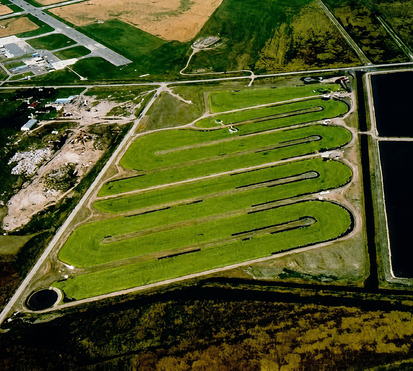 LemTech in Devils Lake, North Dakota, US
That standard has shaped more than fifty years of his practice. Through the Lemna corporation, he has designed wastewater treatment systems using natural biological processes in many countries, including at Devils Lake in the United States and on the Molgora River in Italy. These systems follow the terrain and preserve existing trees and rocks. As a result, the wastewater treatment plant, usually something people prefer to hide, becomes a lake in a park and a good neighbour to the city. In 2004, Regina M. Flanagan noted in Fabric Architecture that these systems, after cleaning the water, also leave behind works of art.
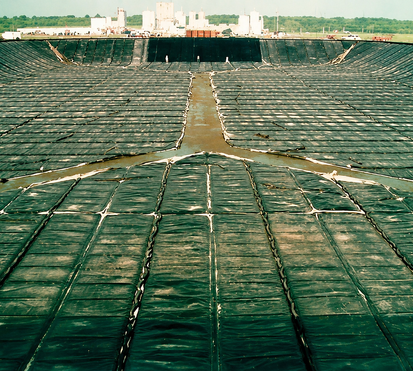 LemTech in Poland
Viet Ngo accepts that his projects may take a long time to reach full performance, sometimes 10 years, sometimes 30. For him, that long-term outcome is the most meaningful kind of art, and also the business philosophy he pursues. TITANs extends this standard to a new challenge: solid waste, plastics and microplastics.
Dematerialization and medium aspecificity
In 1968, Lucy Lippard and John Chandler named a shift then under way in Conceptual Art: the dematerialization of the art object. A work no longer had to be an object. It could be an idea, an instruction, a process, or a system. In 2013, Rosalind Krauss developed the concept of “medium aspecificity.” Under this idea, a work’s artistic status does not come from its material, but from the conventions and internal logic the work establishes for itself.
TITANs creates an intriguing paradox in relation to both ideas. Materially, it would be hard to find anything heavier: hundreds of tonnes of steel, tens of thousands of cubic metres of water, kilometres of liner. Yet what makes it art is entirely immaterial. Its art status does not reside in the steel or the water, but in a decision to call this system a work.
The corporation as medium
In 2002, Maria Eichhorn founded Maria Eichhorn Public Limited Company, a public limited company whose shares are all held by the company itself. As a result, it has no external owners, cannot generate profit, and cannot be bought or sold. By withdrawing capital from circulation, Eichhorn used the market’s own rules to expose the market’s limits, in a critical game played from inside the capitalist system.
Viet Ngo inherits that playful spirit but moves in the opposite direction. Where Eichhorn freezes capital to critique it, Viet Ngo accepts capital and harnesses its system of power. He mobilises financial resources, material resources and technical knowledge to address environmental problems with an almost absolute optimism. Pollution and environmental degradation may be among the hardest problems of our time. The aesthetic sensibility of TITANs may lie precisely in the belief that humanity will eventually overcome them. From this perspective, the company, the contracts, the construction drawings and the building site are no longer means of realising the work. They become the work itself. Critique here has turned into execution, a step rarely seen in art practices, which usually operate at the level of awareness.
Useful Art (Arte Útil)
This shift from critique to execution brings TITANs close to Useful Art. The term originates in the Manifiesto de Arte Útil, written in 1969 by the Argentine artist Eduardo Costa. That same year, Costa paid out of his own pocket to buy and install missing street signs in Manhattan, and then repainted a subway station. These were modest contributions to urban life, but they were also a rebuttal to the idea that art, in order to be art, must be useless and without function.
More than four decades later, Tania Bruguera took up the name and developed it into a movement, founding the Association of Useful Art (Asociación de Arte Útil) through her project Immigrant Movement International in New York. In Spanish, útil means “useful” and also suggests “tool.” For Bruguera, art is exactly such a tool: a process that must produce real effects in everyday life, rather than a contemplative experience set apart from society. Useful Art does not stop at pointing out problems. It becomes a site for proposing and implementing solutions. Nor does it aim to make something already useful more beautiful. It treats usefulness itself as an aesthetic category, which Bruguera describes as art as activism and activism as art.
Together with curators at the Queens Museum, the Van Abbemuseum and Grizedale Arts, Bruguera set out criteria for Useful Art. A project should operate on a 1:1 scale, respond to current urgencies, have practical and beneficial outcomes, pursue sustainability, replace spectators with users, and re-establish aesthetics as a system of transformation. Among the strategies Bruguera outlines is one called “reforming capital.” At the Van Abbemuseum, the Association once posed a question very close to Viet Ngo’s ambition: how can art change the way we act?
TITANs meet these criteria directly. The twin towers are not a model of a plant but the plant itself, operating at a 1:1 scale. In Tatlin’s Whisper #5 (2008) at Tate Modern, Bruguera had mounted police herd and controlled crowds of visitors, so that viewers felt power through their own bodies. At TITAN 01, viewers are likewise invited into a bodily experience as they climb the tower and lean against a column that is actively filtering smoke. What they feel is the labour of infrastructure: the kind of labour that quietly sustains urban life every day and that few people ever see. They are no longer spectators but activated users. Guided by material empathy, Viet Ngo sees labour in every component and finds beauty in their very usefulness. Bruguera once said that Duchamp’s urinal should be put back in the restroom. Viet Ngo’s urinal never left.
One rarely acknowledged reality is that artists seldom have the resources to sustain social-impact projects. This does not diminish the value of Useful Art projects or other socially engaged works. Rather, it asks how the sharp critiques raised by art projects might be carried forward, and brought out into a real world far larger than the world of contemporary art. The critiques these projects raise about institutions, the state, power and the role of art in society remain valid and sharp, and much of that force comes from the marginal position they choose to occupy. Yet even though sustainability is one of the movement’s core criteria, many projects still depend on the budget of a residency, a grant from a museum or the timeframe of an exhibition. They often come to an end when those resources run out, leaving their impact unfinished. Even Costa had to pay for his street signs himself.
Viet Ngo keeps the full spirit of Useful Art while solving this core problem: the lack of resources and the ephemeral, short-term nature of the projects. TITANs is built on the solid foundation of Vietstar, a company with the capital, technical knowledge and operational capacity to sustain the work not for weeks or months but for decades. For an artist accustomed to waiting 10 to 30 years for a project to reach full performance, sustainability is no longer a goal to strive for. It becomes the very condition of the work’s existence.
Open questions
Yet the same capitalist foundation that makes TITANs sustainable also raises questions that Useful Art rarely has to confront. Most Useful Art projects emerge from self-organised groups or individual initiatives that take on tasks once belonging to the state, working from the position of ordinary people on the margins. Waste treatment is also a responsibility of the state. In TITANs, however, it is taken on by a private company, run on investment capital, and then named as art. If the sharpness of Useful Art comes from a marginal position marked by a deep imbalance of power, what does the work gain, and what must it give up, when it leaves that position to stand on a capitalist foundation? When capital is mobilised in the service of the environment, does it truly change, or does it simply put on a cloak of art? And who ultimately benefits: the residents around the plant, the city, or the shareholders?
The criterion of replacing authors with initiators also becomes more complicated here. Viet Ngo is at once artist, investor and designer. Although he gives up authorship to materials and users, he is still the one who holds the structure that allows this to happen.
In 1957, Duchamp proposed the idea of the “art coefficient”: the gap between what the artist intends and what the work actually realises, a gap that only the viewer can complete. Rereading this idea through the lens of usership, Stephen Wright suggests that art is present everywhere, only appearing with different coefficients in different contexts. The question, then, is no longer “is this art?” but “what is the coefficient of art here?”
TITANs does not answer that question. It places it on a smokestack, a pit of water, and a steel frame. What is the coefficient of art of a waste incineration plant?
And if art truly can change the world, how must the artist act, and what must they be willing to give up?